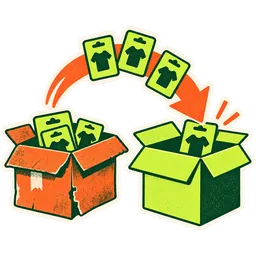
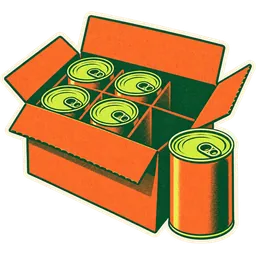
Grocers buy one way and sell another. Coconut water comes in cases of 24 and leaves the store one can at a time. Rice arrives in 25 lb sacks and some customers buy it by the pound. Units make the register and the stock count agree.
How units work
Every product has a base unit, the smallest thing you count, such as a piece, a pound or a kilogram. Bigger units such as a case or a dozen are multiples of the base unit. Purchases and sales are stored in the base unit, so stock is always in one number.
| You buy | You sell | Base unit | Multiple unit |
|---|---|---|---|
| Case of 24 cans | Single cans | Piece | Case = 24 Pieces |
| Box of 12 bars | Single bars or the box | Piece | Box = 12 Pieces |
| Tray of 30 eggs | Dozen | Piece | Dozen = 12 Pieces, Tray = 30 Pieces |
| 25 lb sack of rice | By the pound | Pound (decimals on) | Sack = 25 Pounds |
Create the units
- Open Products → Units.
- Click Add and create the base unit, for example “Piece” with short name “pc”. Leave decimals off.
- Add “Pound” (or “Kilogram”) and tick Allow decimal.
- Add “Case 24”. Tick the option to add it as a multiple of another unit, choose Piece, and enter 24.
- Repeat for each pack size you actually buy.
Name multiple units with the pack size in the name (“Case 24”, “Case 12”) when the same supplier uses several sizes. It saves mistakes on the receiving dock.
Assign units to products
- Open a product or create one.
- Choose its unit, which is the base unit, such as Piece.
- If you turned on sub-units under Settings → Business settings → Products, choose which related units this product can be bought or sold in, for example Piece and Case 24.
- Enter the purchase price and selling price. The software adjusts prices for the bigger unit automatically from the conversion.
Case price versus unit price
Many stores sell a full case for less than 24 single cans. Decide your case price and check the margin:
- Work out your cost per unit: case cost divided by units in the case.
- Set the single-unit price.
- Set or check the case price, and apply a case discount if you give one.
A worked example is on the case and unit pricing page, with a calculator.
Receiving and selling in different units
- On a purchase, choose the case unit and quantity, such as 2 cases. Stock goes up by 48 pieces.
- At the register, the cashier sells pieces. If a customer takes the whole case, the cashier picks the case unit.
- Reports show quantities in the base unit.
Common problems
Stock went negative on canned goods. Purchases were entered in pieces while you meant cases, or the reverse. Check the unit on the last purchase.
The register will not accept 0.75 lb. The unit does not allow decimals. Edit the unit and turn on decimals.
The supplier changed the case size. Create a new multiple unit for the new size rather than editing the old one, because editing changes how old quantities are read.
The case unit is not in the product’s dropdown. Sub-units are not enabled, or that unit is not selected on the product.
Related: Import products from a spreadsheet · Purchase orders and receiving · Case and unit pricing